Why Speaking Clearly Can Help Children Read, Write and Learn Better
Why Speaking Clearly Can Help Children Read, Write, and Learn Better
When parents think about improving their child's English, they often separate the different skills.
Reading belongs in reading class.
Writing belongs in writing class.
Pronunciation belongs in speaking class.
Vocabulary gets practised with flashcards.
Listening happens somewhere in the background.
But in real learning, these skills are constantly interacting.
A child hears a new word before they may ever read it. They often say an idea aloud before they can organize it successfully on paper. They use spoken vocabulary to understand stories, explain reasoning, participate in discussions, ask questions, and make connections between new information and things they already know.
That is why one of the most important ideas behind Speak Clearly at Spark
English Center Vietnam is that improving communication can have benefits far beyond conversation.
Clearer speech certainly matters.
Confidence matters.
Pronunciation matters.
But strong oral language can also help children become stronger readers, more organized writers, and more active learners.
Research on oral-language instruction supports this wider connection. The
Education Endowment Foundation describes oral language as speaking and listening and reports that approaches built around purposeful verbal interaction can have a positive impact on learning, particularly reading comprehension. Its current evidence review estimates an average impact equivalent to around six additional months of progress across the studies it reviewed.
That gives us an important new way to think about children's speaking skills.
A child's voice is not separate from their learning. It is one of the tools they use to learn.
Oral Language Comes Before a Lot of Written Language
Think about how children encounter language naturally.
Long before they write the word enormous, they may hear someone say it.
They hear:
"That dinosaur was enormous!"
They begin connecting the sound of the word with its meaning.
Later, they may use it themselves:
"The whale was enormous."
Eventually, they see the word while reading.
Then, if the vocabulary has become secure enough, they may begin using it independently in writing.
That journey matters.
When children have rich spoken vocabulary, they have more language available to draw upon when they read and write.
This is one reason oral-language approaches often include explicitly developing vocabulary, discussing books, answering questions, retelling information, and encouraging children to explain ideas aloud. These activities help children build meaning around language rather than simply memorizing isolated definitions.
At Spark, this connection is deliberately built into Speak Clearly. The program combines pronunciation and articulation with listening, conversation, expressive language, vocabulary, reading fluency, comprehension, storytelling, and presentation skills rather than treating speech as a completely separate subject.
A Child Can Decode a Word Without Fully Understanding It
This is something teachers see often.
A student reads:
"The exhausted explorer reluctantly continued through the jungle."
They may successfully decode every word.
Excellent.
Then you ask:
"Why didn't the explorer want to continue?"
Silence.
The problem is no longer decoding.
It is language comprehension.
Does the child understand exhausted?
Do they understand reluctantly?
Can they explain the relationship between those two ideas?
This is where speaking and listening become deeply connected to reading comprehension.
A child who regularly discusses vocabulary, explains meanings, answers open-ended questions, retells stories, and uses new words in conversation is doing much more than practising speaking.
They are building the language knowledge that helps them understand increasingly sophisticated texts.
The EEF's oral-language evidence is particularly relevant here because the strongest measured effects in its review were often seen in reading comprehension. Approaches included structured questioning, book discussion, extending spoken vocabulary, and purposeful classroom dialogue.
This is one reason we do not want Speak Clearly to become a class where children simply repeat sounds after a teacher.
Pronunciation is important.
But communication has to have meaning.
Talking Can Help Children Organize Their Writing
One of the most useful things a teacher can sometimes say before a writing task is:
"Tell me what you want to write."
This sounds almost too simple.
But it works for a reason.
Some children struggle with writing because they are trying to solve too many problems simultaneously.
They have to decide what they want to say.
Choose vocabulary.
Build grammatically correct sentences.
Spell words.
Remember punctuation.
Organize their ideas.
Write neatly.
And keep track of the overall message.
That is a considerable cognitive load.
Speaking gives children an opportunity to organize the idea before they also have to manage the physical and technical demands of writing.
Imagine a child trying to write about a school trip.
Their first attempt might be:
"We went zoo and animals and I like tiger because big."
Instead of immediately correcting the page, a teacher might ask:
"Tell me about the tiger."
Suddenly the child says:
"I liked the tiger best because it was really big and it walked right past the glass."
There it is.
A much stronger sentence already exists in the child's spoken language.
Now we can help transfer it to writing.
That is why expressive language is an important part of Speak Clearly.
Students practise explaining, describing, sequencing, expanding answers, and organizing their thoughts rather than only producing correct sounds.
Spark's program explicitly includes vocabulary and expressive-language development alongside speech clarity and fluency.
"I Don't Know" Does Not Always Mean "I Don't Know"
Teachers hear this constantly.
"Why do you think the character hid the letter?"
"I don't know."
Sometimes the student genuinely does not know.
But sometimes they do.
They simply do not yet know how to build the answer.
Perhaps they understand that the character was scared but lack the
language needed to explain cause and effect.
Perhaps they need a structure such as:
"I think _____ because _____."
Or:
At first _____, but later _____."
Or:
"The evidence that makes me think this is _____."
These sentence structures are not only speaking tools.
They are thinking tools.
The more children practise expressing relationships between ideas aloud, the
easier it can become to use those same relationships in written comprehension answers, paragraphs, explanations, and eventually academic essays.
This is particularly relevant for children attending international and bilingual schools, where classroom success increasingly requires students to do more than provide short factual answers. They must explain, justify, compare, predict, describe, interpret, and present their thinking.
Spark's broader academic programs are designed around that same progression from everyday English toward more advanced academic communication.
Speak Clearly gives younger students an opportunity to begin developing those habits orally.
Reading Aloud Is Not Just About Pronunciation Either
Reading aloud sits at an interesting intersection between reading and speaking.
A child needs to decode the words accurately.
But that is only the beginning.
Consider:
"You did WHAT?"
If a student reads that exactly the same way as:
"You did what."
they may have decoded the words, but they have missed part of the meaning.
Expression matters.
Pausing matters.
Punctuation matters.
Phrasing matters.
Reading fluently requires children to group words in meaningful ways rather than treating every word as a separate object.
That is why Speak Clearly includes reading fluency and comprehension as part of communication development.
When children practise reading aloud with appropriate pace, volume, phrasing, and expression, they are learning to think about what the text means and how that meaning should sound.
They are not simply performing words.
They are interpreting them.
Better Listening Can Make Better Speakers
We often focus so heavily on speaking that we forget the first half of communication.
Listening.
A student cannot answer a question effectively if they have not understood it.
They cannot contribute to a discussion if they missed what everybody else said.
They cannot follow multi-step instructions if they stop listening after step one.
They cannot respond appropriately to a classmate if they are only waiting for their own turn to speak.
This is why speaking and listening are so closely connected in oral-language development.
The EEF evidence similarly treats oral language as both speaking and listening, with interventions frequently involving teacher-pupil dialogue, peer discussion, questioning, vocabulary work, and supported verbal interaction.
In Speak Clearly, students therefore practise listening for meaning as well as producing language.
We want students to become children who can not only say:
"Here is my idea."
but also:
"I understand your idea, and here is how mine connects to it."
That is a much more sophisticated communication skill.
Speaking Is Also a Tool for Thinking
This may be the most important new point.
Children sometimes discover what they think while they are saying it.
Adults do this too.
Someone asks you a complicated question and you begin:
"Well... I suppose the reason might be..."
As you speak, the idea becomes clearer.
Language helps us organize thinking.
This is one reason classroom discussion can be so valuable.
When students explain why they chose an answer, compare ideas with
classmates, defend an opinion, or talk through a problem, they are not merely demonstrating knowledge they already possess.
They may actually be developing the knowledge through the conversation.
The EEF specifically notes that oral-language approaches can be used to help pupils develop ideas, make connections with prior knowledge, build vocabulary, and support reading and writing.
That changes the way we think about speaking classes.
A high-quality communication class should not simply teach children how to sound better.
It should help them think more clearly through language.
Why This Matters for International-School Students in HCMC
International-school classrooms require a tremendous amount of oral language.
Students discuss books.
Explain mathematical reasoning.
Collaborate during projects.
Answer inquiry questions.
Present research.
Defend opinions.
Describe scientific observations.
Ask for clarification.
Participate in group discussions.
Reflect on their learning.
And as students grow older, those demands become more sophisticated.
Being conversationally fluent may therefore not be enough.
Spark already makes this distinction in its wider programs: a child may communicate comfortably in everyday English while still struggling with the academic language required to analyze, explain, argue, or discuss complex ideas.
Speak Clearly can help build some of the oral foundations underneath those later skills.
A five-year-old learning to describe a picture clearly is obviously not writing an IB essay.
But they are beginning to learn:
I have an idea.
I can organize it.
I can choose words that make it clearer.
I can communicate it to another person.
Those habits matter.
Why Small Groups Matter Even More for Speaking
There is another practical problem with communication development.
Children need time to talk.
In a class of thirty students, there are simply fewer minutes available for each child's voice.
A confident student may naturally volunteer repeatedly.
A hesitant student may discover that staying silent is surprisingly easy.
Small-group communication classes change that dynamic.
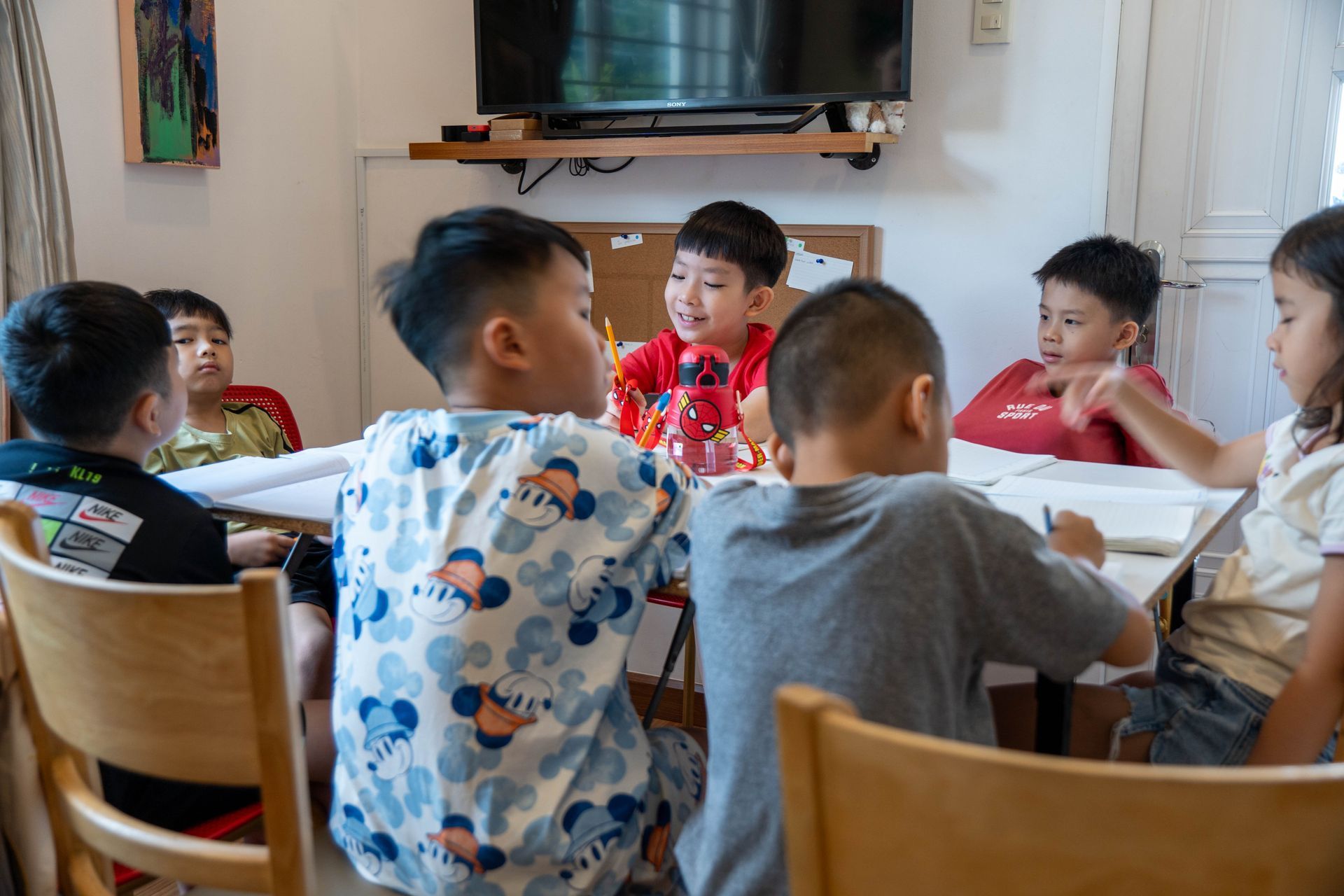
Spark keeps classes to a maximum of six students, creating more opportunities for teachers to hear individual pronunciation, notice recurring patterns, ask follow-up questions, encourage fuller answers, and provide targeted feedback.
Students also gain something that one-to-one instruction cannot always provide:
other children to communicate with.
They have to listen to peers.
Wait their turn.
Ask questions.
Respond.
Disagree.
Clarify.
Explain.
Laugh.
Retell.
Present.
Those are real communication skills.
Speak Clearly Is Not About Creating Perfect Speakers
The name of the program matters.
Speak Clearly.
Not:
Speak Perfectly.
Children will mispronounce words.
They will forget vocabulary.
They will sometimes rush.
They will occasionally say something that makes absolutely no grammatical sense.
That is learning.
The objective is not to eliminate every mistake before children are allowed to communicate.
The objective is to gradually give them more control.
Can I slow down when somebody does not understand me?
Can I try the word again?
Can I explain my idea another way?
Can I use a stronger word?
Can I speak loudly enough to be heard?
Can I listen carefully before answering?
Can I organize my explanation?
Can I stand up and tell people something I know?
That is communication competence.
And over time, those abilities can support much more than conversation.
Signs Your Child May Benefit From More Oral-Language Practice
Parents often notice the symptoms before they know what they mean.
Your child may benefit from additional speaking and communication practice if they regularly have good ideas but struggle to explain them, give extremely short answers despite understanding the topic, avoid reading aloud, rush or mumble, hesitate when speaking to adults or groups, frequently rely on vague words such as thing or stuff, struggle to retell events in a logical order, or understand new vocabulary when listening but rarely use it independently.
Another sign can appear in writing.
If a child repeatedly produces very simple written sentences, ask them to explain the same idea aloud.
If their spoken answer is much richer than their written response, the main challenge may be transferring language into writing.
If their spoken answer is equally limited, vocabulary or expressive-language development may need attention first.
That distinction can be very useful.
What Parents Can Do at Home
You do not need worksheets.
Try asking better questions.
Instead of:
"Did you have a good day?"
try:
"What was the funniest thing that happened today?"
Instead of:
"Did you like the movie?"
ask:
"Which character made the best decision, and why?"
Instead of correcting a vague answer immediately, ask:
"Can you tell me more?"
or:
"What happened first?"
or:
"What word could we use instead of 'thing'?"
Reading together can also become a speaking activity.
Pause and predict what will happen.
Discuss why a character behaved a certain way.
Choose a new word and use it in another sentence.
Ask your child to retell the chapter without looking at the book.
The objective is not to interrogate them.
It is to give language somewhere useful to go.
Why Speak Clearly at Spark Is Different
Speak Clearly is an eight-week structured program for children ages 5–13
focused specifically on pronunciation, articulation, speech clarity, fluency, listening, conversation, expressive language, reading fluency, comprehension, storytelling, and presentation skills. It is designed for both native English speakers and English language learners.
But the bigger idea behind the program is simple:
Speaking is not an isolated skill.
It connects to reading.
It connects to vocabulary.
It connects to comprehension.
It connects to writing.
It connects to classroom participation.
And it connects to confidence.
That is why we believe children deserve opportunities not merely to learn
English, but to actively use language to think, explain, question, understand, and communicate.
Frequently Asked Questions
Can improving speaking really help reading comprehension?
It can. Oral-language approaches that develop vocabulary, discussion, questioning, listening, and spoken expression have shown positive effects on reading comprehension in educational research. The relationship is especially logical when children are learning the vocabulary and language structures needed to understand what they read.
Is Speak Clearly a pronunciation class?
Pronunciation and articulation are part of the program, but Speak Clearly goes considerably further. Students also develop fluency, expressive language, conversation, listening, reading aloud, vocabulary, comprehension, storytelling, and presentation skills.
Is Speak Clearly suitable for fluent English speakers?
Yes. Spark describes the program as suitable for both native English speakers and English language learners. A child may already speak English fluently while still benefiting from clearer pronunciation, stronger expressive language, improved reading aloud, or greater presentation confidence.
Will speaking practice improve my child's writing automatically?
Not automatically. Writing requires additional skills including spelling, punctuation, sentence construction, organization, and transcription. However, developing vocabulary and learning to organize ideas orally can give children stronger language to work with when they begin writing.
What age is Speak Clearly for?
Spark's Speak Clearly program is designed for children ages 5–13.
Is Speak Clearly speech therapy?
No. Speak Clearly is an educational communication program. Children with significant, persistent, or clinically concerning speech difficulties should be assessed by an appropriately qualified speech-language professional.
Why does Spark use small classes for communication?
Spark caps classes at six students. For speaking development, this allows substantially more opportunities for individual participation, teacher observation, feedback, conversation, and peer interaction than students may receive in much larger groups.
Final Thought: Before Children Can Write Powerful Ideas, They Need Language for Those Ideas
We spend enormous amounts of time worrying about whether children are reading enough and writing enough.
Those things matter.
But sometimes we need to listen to them too.
Can they explain?
Can they describe?
Can they retell?
Can they ask?
Can they clarify?
Can they disagree respectfully?
Can they find the words for what they are thinking?
Because language does not begin when a pencil touches paper.
Long before a child writes a convincing paragraph, there is often a sentence they learned how to say.
Long before they understand sophisticated texts independently, there are words they first heard, discussed, and used.
Long before they confidently present a project to a classroom, there are hundreds of smaller conversations in which they gradually discovered how to make their ideas understandable.
That is why Speak Clearly is about much more than pronunciation.
Clearer speaking can become clearer thinking.
And clearer thinking can support stronger learning.
Help Your Child Build a Stronger Voice at Spark
If your child needs support with pronunciation, speaking confidence, expressive language, reading aloud, listening, vocabulary, conversation, or presentation skills, Speak Clearly may be a useful next step.
Spark English Center Vietnam's Speak Clearly program provides a structured communication pathway for children ages 5–13, with small classes and targeted opportunities to develop the oral-language skills they use at school, at home, and in everyday life.