Top 5 Speaking & Communication Classes for Kids in HCMC
Where Can Children Learn to Speak More Clearly and Confidently in Ho Chi Minh City?
A child can know a surprising amount of English and still struggle to communicate.
Some children speak so quietly that teachers and classmates regularly ask them to repeat themselves. Others rush through sentences, mumble, hesitate when answering questions, mispronounce particular sounds, or find it difficult to organize their thoughts when speaking. A student might communicate comfortably with family members but suddenly freeze when asked to read aloud or give a presentation at school.
For multilingual children in Ho Chi Minh City, there can be another challenge. They may spend their days moving between English, Vietnamese, Korean, Japanese, Mandarin, or another home language, and although this multilingual environment can be enormously valuable, children may still need explicit opportunities to develop clear and confident spoken English.
Fortunately, HCMC has several strong options for families who want to develop their child's speaking skills.
For this comparison, we looked specifically at programs according to their emphasis on speech clarity, pronunciation, conversation, listening, expressive language, presentation skills, and speaking confidence for children. This is not a ranking of which organization is the "best English center" overall; it is a comparison specifically for families whose priority is helping a child become a clearer and more confident communicator.
Based on that focus, here are five options parents may want to explore.
1. Spark English Center Vietnam — Speak Clearly
Best for: Children who need clearer speech, pronunciation, expressive language, conversation, reading-aloud, or presentation confidence
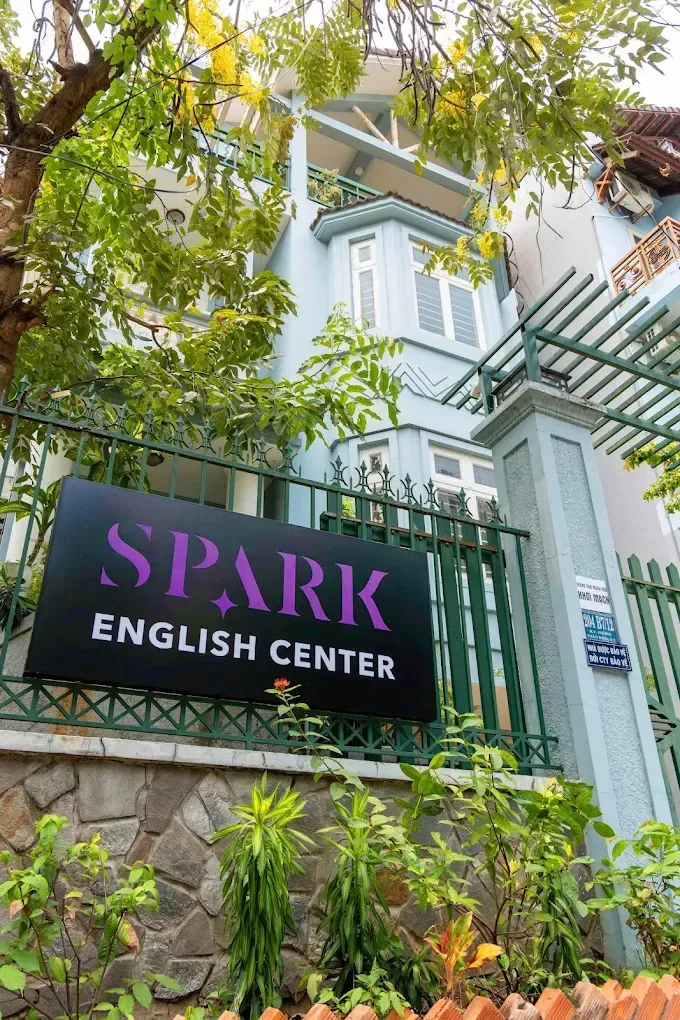
Our first choice for families specifically looking for a children's speaking and communication program is Spark's Speak Clearly program in Thảo Điền.
There is an important reason it takes the top position in this particular comparison.
Many children's English courses include speaking. Speak Clearly is specifically built around speaking and communication.
Spark's Speak Clearly program is an eight-week pronunciation, articulation, fluency, and oral-communication program for children ages 5–13. It is designed for both native English speakers and English language learners, which also distinguishes it from programs primarily intended to teach English as a second language. Spark English Center
The program works across several connected areas:
- pronunciation and articulation
- mouth placement and speech-sound production
- speech clarity and fluency
- listening and conversation
- vocabulary and expressive language
- reading aloud with fluency and expression
- storytelling and role-play
- presentation skills
- confidence when communicating with others
The goal is therefore considerably broader than simply teaching a child to pronounce individual words correctly.
A student may know how to make a particular sound during an exercise but still lose that clarity when speaking quickly in conversation. Another may have perfectly understandable pronunciation but struggle to organize an answer. Another may speak well one-to-one but become extremely nervous when reading or presenting in front of classmates.
Speak Clearly is designed to connect these skills.
Students practise pronunciation, but they also have to use their voices. They talk, listen, describe, read, explain, tell stories, role-play, answer questions, and present.
Spark also deliberately distinguishes speech clarity from accent reduction. The goal is not to make multilingual children sound identical or remove the accent associated with their family or cultural background. The goal is intelligibility: helping children communicate their ideas clearly enough to be understood.
For international- and bilingual-school families, this can be especially relevant because oral communication is increasingly part of everyday academic life. Students are expected to contribute to discussions, explain their reasoning, collaborate on projects, read aloud, answer questions, and eventually deliver presentations.
Spark's wider English programs also emphasize small classes, with the center stating a maximum of six students, which can provide considerably more opportunities for individual speaking and teacher feedback. Spark English Center
Why we ranked it #1: Of the programs reviewed here, Speak Clearly has the most specialized published curriculum specifically centered on children's speech clarity and oral communication rather than treating speaking as one part of a broader general-English course.
Particularly worth considering if your child: speaks unclearly, rushes or mumbles, struggles with certain sounds, avoids reading aloud, has difficulty explaining ideas, gives very short answers, or lacks confidence speaking in groups.
2. British Council Vietnam — Secondary English
Best for: Teenagers who want stronger conversational confidence and discussion skills
The British Council Vietnam is an excellent option for families looking for an established international English organization with a strong communication component.
Its Secondary English program is particularly relevant to this comparison because it explicitly emphasizes helping teenagers become confident English communicators.
Students participate in lively speaking lessons, discussions, practical tasks, teamwork, and activities encouraging self-expression and creative thinking. Collaboration and leadership are also incorporated into the course. British Council
That makes it particularly attractive for teenagers who already have some English but need more opportunities to actually use it.
There is an important difference from Spark's Speak Clearly program, however.
British Council's course is a broader English program. Speaking is important, but students are developing English proficiency more generally rather than attending a course specifically centered on articulation, speech clarity, and oral-language development.
For some students, that is exactly what they need.
A teenager who speaks clearly but needs richer vocabulary, greater conversational confidence, more experience expressing opinions, and stronger academic communication may benefit considerably from that broader approach.
Why it ranks highly: Strong emphasis on communication, discussion, collaboration, and self-expression within a well-established English-learning pathway.
Particularly worth considering if your child: is a teenager who wants to become more comfortable discussing ideas and communicating in English rather than needing targeted pronunciation or articulation work.
3. ILA Việt Nam - Trụ sở chính — Super Juniors & Smart Teens
Best for: Children who want communication development alongside general English
ILA Vietnam is another strong contender, particularly for families looking for communication development within a comprehensive English curriculum.
For primary-age children, ILA's Super Juniors program incorporates communication alongside collaboration, creativity, critical thinking, technology, and self-improvement. Its published curriculum also emphasizes developing fluent speaking and confident participation through play- and project-based learning. ILA Vietnam
For older students, Smart Teens develops listening, speaking, reading, and writing while incorporating communication, collaboration, projects, and self-expression. ILA Vietnam
This makes ILA especially interesting for students who need general English development and stronger speaking confidence at the same time.
Project-based learning can provide valuable reasons to communicate. Instead of answering isolated questions solely because a teacher has asked them, students may need to discuss an idea, collaborate, explain something, or present the result of a project.
Those are useful communication experiences.
Again, however, the distinction is specialization. ILA is teaching comprehensive English, with speaking as one important component. A child whose primary challenge is articulation or specific speech clarity may therefore need a different kind of program from a child whose main goal is becoming more fluent and confident using English generally.
Why it ranks #3: Strong communication and project-based elements combined with a well-developed general-English pathway for children and teenagers.
Particularly worth considering if your child: needs speaking practice as part of broader development across listening, speaking, reading, and writing.
4. Trung Tâm Apollo English Phạm Ngọc Thạch — Children's English
Best for: Children who need an encouraging environment in which to start using English
Apollo English places substantial emphasis on children developing the confidence to actually use English rather than simply memorizing it.
Its current programs cover kindergarten, primary, secondary, and older learners, and its teaching materials describe communication through activities such as storytelling, games, role-play, and presentations. Apollo also emphasizes using grammar in real conversations rather than treating it only as something students memorize for exercises. Apollo English
For younger children, this approach may be particularly valuable.
A child who is nervous about speaking does not always need someone repeatedly telling them:
"Speak!"
They need something they actually want to talk about.
Games, stories, role-play, projects, and playful interactions can lower the perceived stakes of communication and encourage children to experiment with language.
Apollo's primary program also connects English development with confidence, independence, and communication, while its broader methodology emphasizes individualized progress and active participation. Apollo English
This makes Apollo a potentially good fit for children who need to become more comfortable using English naturally.
Why it ranks #4: Strong emphasis on active communication, storytelling, role-play, presentations, and building children's confidence within a broader English curriculum.
Particularly worth considering if your child: needs a lively environment where speaking develops naturally alongside general English.
5. Anh Văn Hội Việt Mỹ VUS - Nguyễn Văn Thủ - Quận 1
Best for: Families looking for a large English-school network with communication incorporated into broader language study
VUS is another major English provider in Ho Chi Minh City and can be worth considering for families whose goal is general English proficiency with speaking and communication incorporated into the curriculum.
For this particular list, however, the distinction between communication practice and a specialist communication program remains important.
A broad English course normally develops several areas simultaneously: listening, speaking, reading, writing, vocabulary, and grammar. That can be exactly right for a child whose overall English proficiency needs development.
A student who already has strong English but has a very specific difficulty with pronunciation, articulation, expressive language, reading aloud, or presentation confidence may instead benefit from a program concentrating more heavily on those areas.
That is why VUS appears lower on this particular list—not because a broad English program is inherently less valuable, but because our ranking is specifically about speaking and communication specialization for
children, rather than English education overall.
Particularly worth considering if your child: needs broader English development and your family values the convenience and structure of a large language-school system.
What Kind of Speaking Class Does Your Child Actually Need?
This is probably the most important question in the entire article.
Parents often tell us:
"I want my child to speak better."
But better can mean ten completely different things.
One child may need to pronounce certain sounds more clearly.
Another needs vocabulary.
Another needs to stop rushing.
Another needs practice constructing complete answers.
Another understands English but is afraid to speak.
Another communicates beautifully in conversation but panics during presentations.
Another speaks confidently but reads aloud without appropriate pacing or expression.
And another simply needs much more exposure to English.
Those children should not automatically be placed into the same type of program.
Before enrolling anywhere, try to identify what happens when communication breaks down.
If your child doesn't know what words to use, vocabulary and general English development may be the priority.
If they know what they want to say but struggle with how particular sounds or words come out,
pronunciation and articulation deserve closer attention.
If they speak clearly at home but become silent in class, the issue may be speaking confidence.
If their individual words are clear but their explanations are confusing, they may need support with expressive language and organization.
And if they speak confidently but struggle when reading aloud, decoding, reading fluency, phrasing, or comprehension may be part of the problem.
Finding the cause is much more useful than simply enrolling a child in "more English."
Why Speaking Confidence Matters at School
Communication becomes increasingly important as children progress through school.
Students are not only expected to know answers. They have to explain them.
They participate in group discussions, ask questions, work collaboratively, explain mathematical reasoning, retell information, defend opinions, read aloud, contribute to projects, and give presentations.
A child may have an excellent idea but struggle to demonstrate their understanding if they cannot communicate it effectively.
That is one reason speaking development should not be reduced to pronunciation.
A confident communicator needs vocabulary, sentence structure, listening skills, clarity, fluency, appropriate
pace and volume, and the ability to adapt when the listener does not understand.
Most importantly, children need repeated experiences that teach them:
My ideas are worth sharing, and I know how to share them.
Our 2026 Ranking for Children's Speaking & Communication in HCMC
For families specifically prioritizing children's oral communication, our shortlist is:
1. Spark English Center Vietnam – Speak Clearly
Best specialist option for pronunciation, articulation, speech clarity, expressive language, reading aloud, conversation, and presentation confidence.
2. British Council Vietnam
Best for teenagers developing communication, discussion, collaboration, and broader English confidence.
3. ILA Vietnam
Best for communication and speaking development within a comprehensive English program.
4. Apollo English
Best for interactive speaking, role-play, storytelling, and general communication confidence.
5. VUS
Best for families wanting communication practice within a broad English-learning pathway and large center network.
The ranking is deliberately based on speaking and communication specialization, not which organization is "best" overall. A different goal—IELTS preparation, beginner ESL, academic writing, or exam preparation—could produce a very different order.
Frequently Asked Questions
What is the best speaking class for children in HCMC?
For families specifically looking for a program centered on speech clarity and oral communication rather than general English alone, our top choice is Spark English Center Vietnam's Speak Clearly program. It combines pronunciation and articulation with conversation, expressive language, listening, reading fluency, storytelling, and presentation practice for children ages 5–13. Spark English Center
Is Speak Clearly only for children learning English as a second language?
No. Spark designed Speak Clearly for both native English speakers and English language learners who could benefit from clearer speech, stronger pronunciation, or greater communication confidence. Spark English Center
Does my child need a communication class if they already speak English fluently?
Possibly. Fluency and communication effectiveness are not identical. A fluent speaker can still rush, mumble, struggle with particular sounds, give poorly organized explanations, avoid reading aloud, or lack confidence presenting in front of others.
Will a speaking class remove my child's accent?
That should not be the objective. An accent is part of normal linguistic diversity. For most children, the useful goal is intelligibility—being able to communicate clearly enough that listeners can understand them without unnecessary difficulty.
What is the difference between a speaking class and a general English class?
General English typically develops listening, speaking, reading, writing, vocabulary, and grammar together. A specialist communication program places much greater attention on the mechanics and practical use of spoken communication, such as articulation, pronunciation, fluency, expressive language, conversation, reading aloud, and presentations.
My child is very shy. Can speaking classes help?
They can provide structured opportunities to practise speaking in lower-pressure situations. The goal should not be to force a naturally quiet child to become extroverted. Instead, children can gradually learn that they are capable of answering, explaining, reading, presenting, and making themselves heard when they choose or need to.
What if my child has a significant speech difficulty?
A children's English communication program is not a replacement for speech-language therapy. If a child has persistent or substantial speech difficulties, parents should consider seeking advice from an appropriately qualified speech-language professional.
Final Thought: The Goal Isn't to Create the Loudest Child in the Room
When parents say they want their child to become a confident speaker, it can be tempting to imagine a child standing on a stage, speaking loudly and fearlessly in front of hundreds of people.
But communication confidence is often much quieter than that.
It is the child who raises their hand even though they are not completely certain of the answer.
It is the student who says, "Could you explain that again?"
It is being able to read a paragraph aloud without rushing because other people are listening.
It is explaining an idea clearly enough that a teacher understands.
It is joining a conversation instead of standing silently beside it.
It is making a pronunciation mistake, correcting it, and continuing to speak rather than becoming embarrassed and giving up.
Those small moments gradually create capable communicators.
And ultimately, that is the goal.
Not perfect English.
Not identical accents.
Not children who never hesitate.
Children who know how to make themselves understood—and have the confidence to try.
Help Your Child Speak Clearly at Spark
Spark's Speak Clearly program is designed for children ages 5–13 who want to develop clearer pronunciation, stronger articulation, better listening and conversation skills, expressive language, reading fluency, storytelling, presentation skills, and greater communication confidence. Spark English Center
Every child's communication profile is different, which is why identifying the specific area that needs development should come before deciding what kind of support they need.
Explore the Speak Clearly program at Spark English Center Vietnam